
Note: I wrote this at the beginning of last year (January 2025), and promised myself I would finish it before year’s end. Well, that didn’t happen. Broken promises and all, here it is a month after my last post. Enjoy.
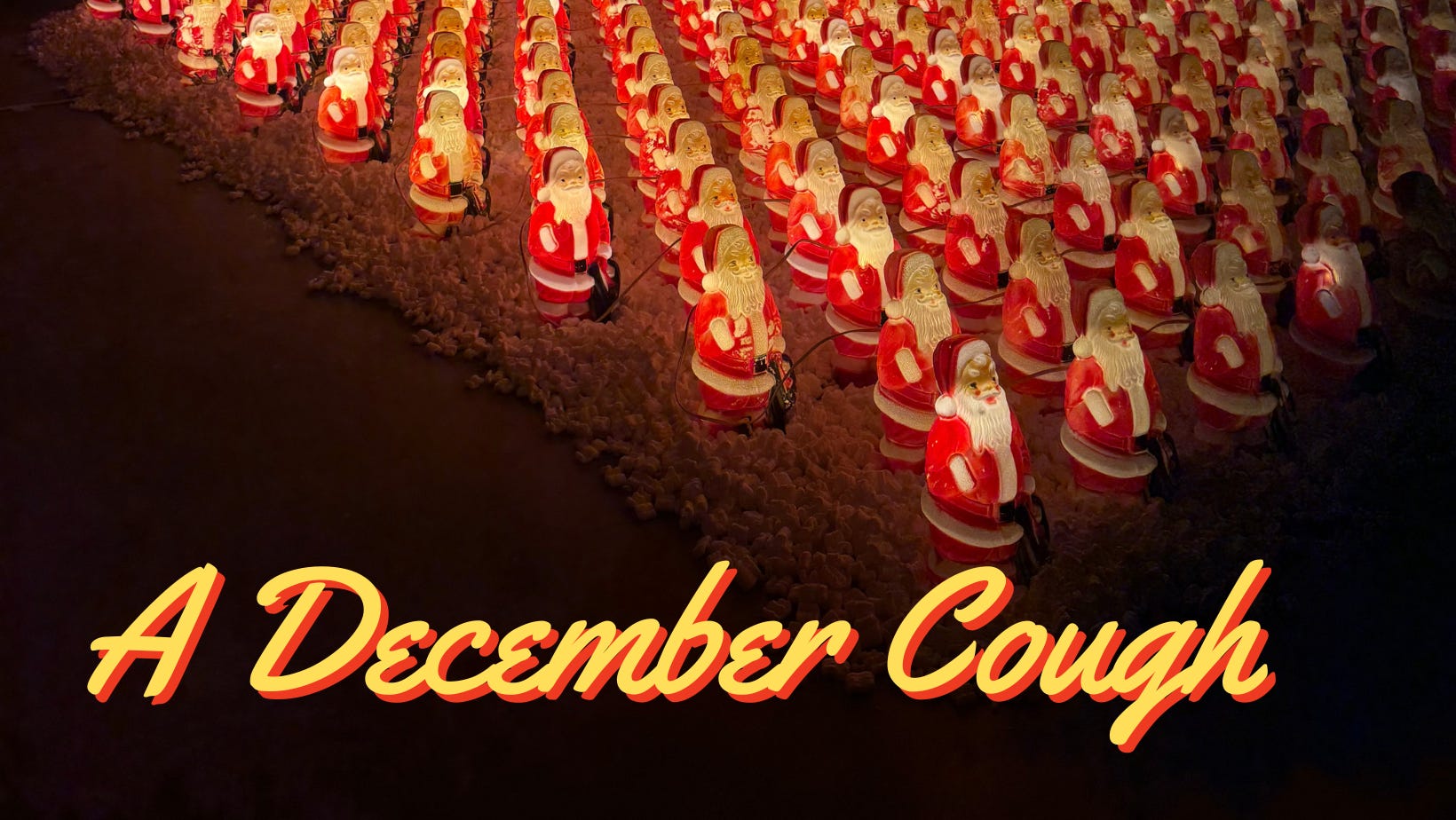
“It’s quite possible he’s allergic to Christmas trees?”, my pediatrician tells my mother, an air of uncertainty lingering. Almost every December during my childhood, I would get sick. Like clockwork, the minute Thanksgiving’s festivities ceased, an irritation would tickle my throat, turning into a full blown cough. My doctor nicknamed it my “December cough” - dry, some mucus, but no other symptoms.
The Christmas tree theory never panned out. Too many Christmases living outside of Portland came and went with no cough. No mess of prescribed antibiotics worked either; grinning and bearing it became my only tactic. By January, the cough would disappear all together, as quickly as it arrived. Slowly, I would forget it even existed… Until the following December.
Wet Portland winters felt like a perfect breeding ground for fungus and mold, camping out in my lungs during the holidays to survive the dark, brooding months of winter. Just like any of us are trying to do.
After finishing a run during the first week of December, a familiar tickle returned, like an old friend who always brought trouble with them. I woke up the next morning hacking - the cursed nostalgia had returned. With Christmas on the horizon, all I wanted was for the sickness to leave.

My memories of Christmas in Portland always involved my parents. We schlepped to the nearby Boy Scout pop-up, the smell of pine and chainsaw fumes washing the air, Christmas tree cookies and branches scattered across the trampled grass.
While my father and I readied the tree, my mother would pull out the thousand or so boxes that seemed to materialize from nowhere in the garage, filled with ornaments, stockings, and Christmas decorations passed down through generations.
Her decorating was an exquisite operation. Every item had a specific place in the house. Even then, I wondered if I would someday inherit the entire collection when my parents passed. My head spun at the amount of storage space it would require.
After I left for Ukraine in 2015, my mother’s decorating began to dwindle. Fewer boxes came out each year, often accompanied by a trailing, “Oh, I guess I didn’t feel like decorating as much this year.” When my parents moved to Phoenix in December of 2017, Christmas felt almost forgotten. I arrived one Christmas eve night to find a Charlie Brown tree inside their home, decorations clinging to it for dear life.
While living in New York City in early December of 2021, I stared at a missed call from my father while dining out. My father never calls anyone. Stepping out into the winter wind tunnel of Park Ave in Manhattan, I was barely able to make out my father’s broken voice;
“Your mother fell.”
While decorating the front entryway of their house in Phoenix, my mother misplaced her footing, falling down a flight of stairs. She would pass away a month later from injuries related to the fall. Christmas hasn’t felt the same since.
The cough returned at a strange moment in my life. Six months earlier, I had left New York City after three years - the loss of a job and a relationship happening at once. The last time I had lived in Portland was a decade prior, and the cough was a distant childhood memory. Now it returned like a brood cicada emerging from a long sleep.
Being back in Portland felt familiar yet foreign, like a face you recognize in a crowd but can’t place. I carried the naïve confidence that I could return to my birthplace and act as if I had never left. Instead, I found myself grasping for anything that might keep me grounded.
This would be my first Christmas in Portland without my immediate family. My father and older sister still lived in Phoenix, and I couldn’t bear the weight of being there for the holidays. Phoenix isn’t exactly synonymous with Christmas - something about celebrating in 70 degree weather never fit the mood. My father barely celebrates now anyway; the thousands of boxes of decorations have all been donated.
My community had changed too. While I’d been gallivanting around the world over the last decade, friends in Portland had built full lives - many now married, and with children. Even with their generous holiday invitations, the gatherings were undercut by a sense of something looming. I felt like I was inserting myself into traditions that no longer belonged to me, a layer of cream sitting on top of fresh coffee.
Now it was just me, and a few relatives I barely spoke with anymore.
Returning to Portland had already stirred reminders of my mother from my youth. During the holidays, those reminders multiplied. Everywhere I went, her presence followed me, the memories omnipresent. December pressed its thumb deeper into a fresh bruise.
I told myself I would persevere through the grief. I wouldn’t let it take this year from me too.
The cough had other ideas.
By the second week of December, Fisherman’s Friend menthol cough drops had become my best friend. We were attached at the hip, a box stuffed into every jacket pocket I owned. They were my only saving grace.
The doctor’s visit felt like déjà vu, their lines almost rehearsed.
“Are you sure you aren’t allergic?”
With no other symptoms, they decided I wasn’t contagious and called in a prescription to the nearby pharmacy. I stared at the opaque orange bottle in my hand, knowing it wouldn’t help. This wouldn’t be a fair fight.
Robin Pecknold of Fleet Foxes played the Aladdin Theater, and I went in convinced I could keep the cough at bay with my arsenal of drops and DayQuil. By the third song, I was hacking violently into my jacket. Self-consciousness followed me everywhere, convincing me I was turning into a social pariah.
The cough was most tenacious at night. My bed became a war bunker, sleeping in short stints - 40 minutes there, two hours there - only to wake in a half daze, hacking over the bathroom sink, my eyes bloodshot, as a tired disappointed face stared back in the mirror.
Running usually kept me sane; the cough made it impossible. I couldn’t sleep, I couldn’t run, I couldn’t think clearly. I was falling apart. And everything smelled and tasted like menthol.
Grief slipped in through the cracks of my exhaustion, settling in my chest alongside the cough. They worked in tandem, beating me down. Holding back the cough felt like holding back grief - irritating, pointless, and exhausting.
My favorite time in New York City was the stretch from the weekend before Christmas through New Year’s. The streets emptied. Everyone left for the holidays, taking the chaos with them. Freezing temperatures competed with the dry air. From my fire escape in Park Slope, I watched the snow come down. I walked through Prospect Park, birdsong and rustling winter leaves filling the air where children screaming, dogs barking, and bass from portable speakers usually lived. The city felt manageable. I could keep it warm in my hands, and keep it there. I could breathe.
I wanted to exist peacefully in the city while still loving its mayhem. I was grieving my mother, though I didn’t recognize it as grief at the time. I missed the nuance of it all. Deep down, I knew this feeling only arrived once a year.
I had become spoiled. Portland could never compete with Christmas in New York. You couldn’t turn a corner without decorations—tucked into subway grates and rat-infested garbage cans. Even the hot dog vendors decorated. Christmas in New York felt bigger than Christmas itself.
I lay in bed, hacking, memories of New York holidays tumbling through my head, wondering why I had ever left.
Somewhere within the few brain cells still firing, I landed on a pseudo-scientific hypothesis: if I could find my Christmas spirit, I could use it to beat the cough—and maybe whatever grief had settled into my body.
I visited relatives who still lived in the Portland area, grateful for the warmth of a holiday gift exchange. Most of the time was spent jokingly complaining about my father, who had been diagnosed with Parkinson’s a few months after my mother’s death.
While I appreciated their hospitality, there was still no Christmas spirit. I couldn’t stop thinking about how fragile everything suddenly felt, how quickly one parent had already slipped away.
I wanted - needed - to be overwhelmed with holiday cheer. I visited my last resort - Washington Square, the mall of my suburban upbringing. Surely somewhere along its miles of polished floors, bombastic holiday music, and chaotic last minute shoppers, I could “feel Santa and God in this mall tonight”.
Nothing. Washington Square was barely decorated, a sorry display of a Santa’s workshop.
I did all the Christmas things! I strolled Peacock Lane, Portland’s famous Christmas street! I made eggnog! I stood in front of the Christmas tree downtown! I stared into the lights until my retinas burned red and green! I even consider singing Christmas carols to neighbors with my raspy, broken, voice.
Still nothing. Everything was coated in a smudge, as if I were moving through the world behind a dirty window.
The cough only grew stronger. Grief and sickness tangled together, like a pair of bullies holding my face in cold mud.
When Christmas Day came and went, I accepted what I already knew from childhood: the only way out of this coughing mess was through.
I’ve always felt I could trust people who keep their lights up past the holidays. Not that those who take them down immediately are untrustworthy, but there’s a shared understanding of the stretch between the end of December and the first warm day of spring. Those are my kind of people. In Portland, that stretch can feel brutal - temperatures hovering in the high 30s, rain spitting instead of snow. No holidays ahead, just a long gray road. Just anxiously awaiting for the day the sun kisses your face and feel its warmth.
The holiday lights become quiet signals to others who fight the dying light of day, even as the clouds linger, never moving.
By the end of January, the cough is a distant memory. I’m driving down Cesar Chavez with friends when my eyes catch on a house glowing against the overcast sky. It’s still fully decorated, Christmas lights blazing in defiance. The house refuses to concede to January, to the gloom waiting in the months ahead. Something in me breaks. The emotions I’ve been carrying for weeks finally surface, spilling out in the car.
“It used to be so much easier,” I manage between short breaths and tears. “Everything used to be so much easier.”
Life used to be easier. The lights offer a brief return to a time when it didn’t feel so heavy - before grief took up so much space. Grief works slowly, lurking in the shadows, until one day it’s just a tickle in your throat.
.
.
.
Thank you for reading. Hope you have a Happy New Year.